
Huashan is not a casual hike. The Plank Walk alone has a 700-year history, and the queues can eat three hours of your day if you show up late. The mountain also has vertical ladders, icy ridges in winter, and cable car logistics that confuse first-time foreign visitors.
This guide doesn’t give you pretty viewpoints. It gives you a safety-first action plan for every dangerous section: exact arrival times to beat the Plank Walk queue, mandatory gear you shouldn’t skip, and three tested itineraries depending on how much fear you want to feel.
It’s a 40-page PDF you can download and use offline — no signal needed when you’re gripping an iron chain at 2,000 meters.
Instant digital download · Free Online support · Mobile-optimised
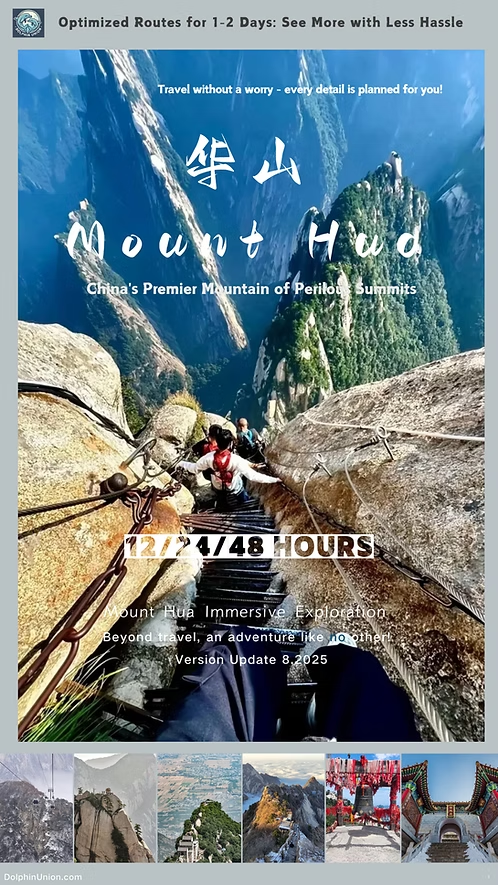
Mount Hua extreme‑hiking PDF guide for thrill‑seeking foreign visitors. Master the Plank Walk, sunrise routes, seasonal safety tips, ticket & cable‑car booking, plus copy‑paste Amap navigation links. Three tested hiking itineraries for day‑climb, night‑sunrise hike & five‑peak traverse. Updated 2026.
A practical overview of Huashan logistics: train times, ticket booking, route selection, and essential safety tips—designed for first-time foreign visitors.
[Read the blog →]
Step-by-step instructions for linking international cards, verifying identity, and fixing the most common payment errors when using Alipay or WeChat Pay in China.
[Read the blog →]
Want to test our travel resources before ordering full city guides? Visit our dedicated page to download free China travel guide PDFs:
📥 9-City Preview Guide (Free PDF) – Sample Beijing travel routes and snapshots of Shanghai, Chengdu, Xi’an and other famous destinations
📥 China Travel Toolkit (Free PDF) – Must-know advice on mobile applications, cashless payment, translation solutions and internet connectivity for overseas visitors
Best Time to Visit
April–May and September–October: stable temperatures, fewer thunderstorms, and full cable car operations. Avoid July–August for afternoon storms and winter (Dec–Feb) unless you have ice climbing experience and proper gear.
From Xi’an North Station, take the high-speed train to Huashan North Station — 28 minutes, ¥54. Then take the mandatory shuttle bus (¥40 round trip) to the visitor center. Choose either West Peak cable car (¥140, 20 min) or North Peak cable car (¥80, 8 min) depending on your route. The guide includes exact train times and transfer steps.
Most foreign travelers can use the 240-hour transit visa-free policy when arriving via Xi’an or other major hubs. If you’re flying into Xi’an Xianyang International Airport, check whether you qualify for visa-free transit before booking domestic trains to Huashan. Always confirm the latest policy with your airline.
A: The main paths are well-maintained, but the Plank Walk and Sparrowhawk’s Flip require no fear of heights and decent upper-body strength. First-timers should stick to the 12-hour speed climb and skip Sparrowhawk’s Flip.
A: Yes, but only with ice cleats, thermal layers, and a headlamp. The Plank Walk is closed from November to March, and many sections freeze solid. The guide includes a full winter gear checklist.
A: Be at the Plank Walk entrance by 7:00–7:30 AM. After 9 AM, queues often exceed 2 hours on weekends. The guide breaks down exact timing for weekdays vs. weekends.
A: Headlamp (200+ lumens), gloves, water (2L), power bank, and in winter, microspikes. The full checklist is inside the PDF.
A: Yes. Every scenic spot, hotel, and restaurant comes with copyable Chinese addresses for one-click Amap navigation — designed for overseas travelers who cannot read Chinese.
A: Night hiking is allowed for beginners only if you follow the gear and timing rules inside the guide. Avoid night climbs in winter due to icy trails.
My first time on the Plank Walk, my legs were shaking so badly I couldn’t grip the iron chain. I remember thinking, “This is how people end up on rescue videos.” But after two complete ascents across different seasons, I learned that fear comes from not knowing the exact sequence — where to stand, when to move, how to slide the safety clip without freezing up.
That’s why this guide is built as a survival system, not a travel brochure. You’ll get the exact queue times for the Plank Walk (7:30 AM vs. 9 AM makes a 2–3 hour difference), the mandatory gear that most people forget, and step-by-step movement techniques for vertical sections like Thousand-Foot Crest and Sparrowhawk’s Flip. I also include three tested itineraries: a 12-hour speed climb for adrenaline junkies, a 24-hour night hike to catch sunrise at East Peak, and a 48-hour five-peak traverse for seasoned climbers. Each route has hour-by-hour train times, cable car choices, and hotel addresses in both English and Chinese.
I’ve also included a script you can show staff to rent Mount Hua’s new exoskeleton robot — a powered leg support that reduces strain by 30–40%, so you save energy for the scary parts. It’s the kind of detail you won’t find on free blogs.
You don’t need more photos of cliffs. You need to know what time to start, what gear to pack, and what to do when your legs start shaking. This PDF answers all of that, offline, in your pocket, while you’re standing at the edge.
Why go: Home to the Terracotta Army, ancient city walls, and the Muslim Quarter’s street food scene. A deep dive into Chinese history and a natural pairing with Mount Hua — Xi’an is the closest major city to the mountain.
Best for: History buffs, food lovers, and travelers who want to mix mountain adrenaline with imperial grandeur.
Travel tip: Take the high-speed train from Huashan North Station to Xi’an in about 30 minutes. Visit the Terracotta Army at opening time to beat the crowds, then ride a bike on the ancient city wall at sunset.
Why go: Giant pandas, fiery Sichuan cuisine, and a famously laid-back teahouse culture. Chengdu is the perfect place to unwind and eat well after the physical demands of Mount Hua.
Best for: Animal lovers, foodies, and anyone seeking a slower, more indulgent China experience.
Travel tip: High-speed trains from Xi’an to Chengdu take about 3–4 hours. Book the panda base’s early morning session to see pandas at their most active, then spend the afternoon in a People’s Park teahouse.