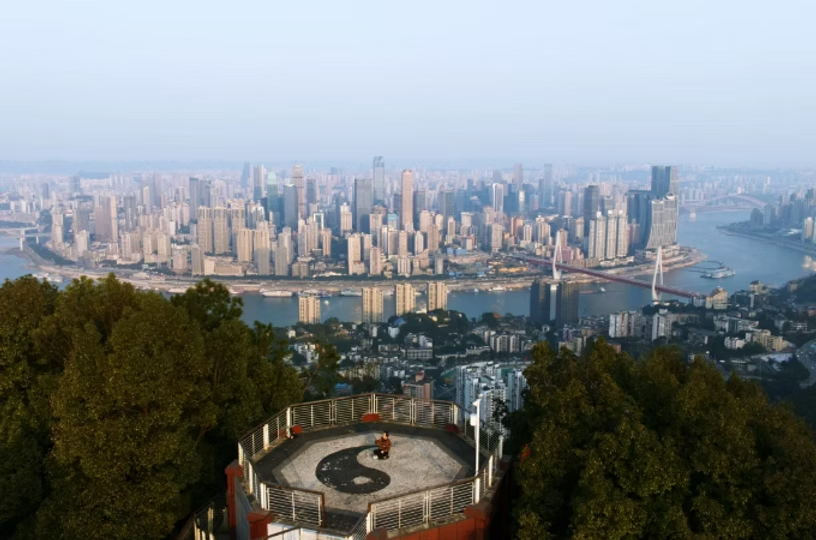
A one day in Jiaxing is absolutely enough. The Hangzhou to Jiaxing high speed train takes only 23 minutes, and the city’s compact old town + lake + food scene makes it one of the best day trips from Hangzhou for slow travelers. Expect to spend about ¥250–350 (roughly $35–50) for the whole day, including transport, food, and an optional boat ride. No rushing, just easy Jiangnan vibes.
Last weekend I almost skipped Jiaxing entirely. I was in Hangzhou, already tired from West Lake crowds, and the idea of another “must-see” destination felt exhausting. Then a friend texted: “Just take the 23-minute train to Jiaxing. Eat zongzi, walk old streets, don’t plan anything.”
So I went. And honestly? It ended up being one of my favorite day trips from Hangzhou all year. If you’re looking for a Jiaxing day trip from Hangzhou that doesn’t feel like a military operation, this is it. No 6am alarms, no sprinting between attractions. Just a relaxed one day in Jiaxing with old stone streets, a beautiful lake, and enough local food to ruin your dinner plans.
Here’s my honest, no-fluff Jiaxing travel guide for foreigners—written for travelers who want a real Jiangnan water town day trip without the tourist traps.
Hangzhou to Jiaxing High Speed Train: How to Get There
Let me make this simple: the Hangzhou to Jiaxing high speed train is the easiest intercity trip you’ll take in China.
- Route: Hangzhou East (杭州东) → Jiaxing South (嘉兴南)
- Fastest duration: 23 minutes
- Second-class seat: ¥37 (about $5.20)
- First train out: 04:11
- Last train back to Hangzhou: 21:56
Trains run frequently throughout the day—I showed up at the station with no ticket and still got on a train within 20 minutes. But if you’re traveling on a weekend or public holiday, buy your ticket in advance on Trip.com or the official 12306 app. Foreigners can use passport registration on both platforms now.
Jiaxing South Station to the old town: Once you arrive, don’t bother with the metro—it doesn’t reach the historic core yet. Just take a DiDi (Chinese Uber) to Yuehe Ancient Street. It’ll cost around ¥15–20 and take about 15 minutes. If you’re on a budget, bus routes are available but slower and harder to navigate without Chinese.
My honest take: The high-speed train part is so painless that you could theoretically leave Hangzhou at 9am, eat lunch in Jiaxing, and be back by 6pm. But I’d suggest taking your time—that’s the whole point. It’s honestly one of the easiest best day trips from Hangzhou you’ll ever do.
Pro tip: If you’re planning a full Hangzhou itinerary and want more local routes, avoid-the-crowds tips, and navigation shortcuts, check out my 96-Hour Hangzhou Cultural Immersion Guide. It’s built for travelers who actually want to experience the city, not just check off landmarks.
One Day in Jiaxing: The Slow Travel Itinerary
This itinerary follows a logical geographic flow: start north in the old town, gradually move south toward South Lake, and end in the modern converted factory district. No backtracking, no stress.
Stop 1: Yuehe Ancient Street (月河历史街区)
Time needed: 1.5–2 hours
Ticket: Free
Best for: Old canal vibes, local breakfast, non-touristy photo spots
Yuehe Ancient Street is the Jiaxing I’d been hoping for—narrow stone lanes along a branch of the Grand Canal, with wooden houses, tiny flower markets, and the warm smell of freshly steamed zongzi drifting out of doorways.
I arrived around 9:30am on a Friday and had the street nearly to myself. By 11am, a few tour groups showed up, but nothing like the chaos in Wuzhen or Xitang. Honestly, if you can, go on a weekday morning—weekends here do get noticeably busier, especially around the food stalls. Lunchtime on weekends gets absolutely packed, so try to avoid peak hours if you can.
Don’t miss the flower and bird market tucked inside the old buildings. There’s something wonderfully local about watching elderly residents haggle over orchids while you sip a ¥5 cup of tea on the steps. For photography, the small stone bridges are your best friend—cross one, turn around, and you’ll get that classic Jiangnan reflection shot without any crowds.
If canal life interests you, I’ve written separately about riding the Hangzhou Water Bus through the city’s own canal network. It’s a similarly local, slow-paced experience: Hangzhou Water Bus: The Local’s Guide to Riding the ¥3 Canal Boat for Foreign Travelers.

Stop 2: Zicheng Heritage Park & the Gothic Catholic Church (子城遗址公园 + 天主教堂)
Time needed: 45–60 minutes
Ticket: Free
Best for: Surprisingly good photos, quiet green space, a snack break
I’m going to be honest: I came here mostly because it was on the way to South Lake. I left thinking it might be the most underrated photo spot in Jiaxing.

The Zicheng Heritage Park sits on the ruins of an ancient city wall, but it’s less “museum” and more “pleasant public lawn.” Next to it stands a Gothic-style Catholic church—built in the early 20th century—that looks straight out of Europe. The contrast between old Chinese archaeology and the church spires is oddly beautiful.
The lawn in front of the church is more photogenic than many paid scenic spots I’ve visited. Bring a coffee, sit on the grass, and watch local families fly kites. I spent 40 minutes here doing absolutely nothing, and it was exactly what I needed.

Stop 3: South Lake Jiaxing (南湖景区)
Time needed: 2 hours
Ticket: Free to enter; boat ride costs extra
Best for: Lake views, revolutionary history, a relaxing boat tour
South Lake Jiaxing is the city’s most famous landmark, partly because of its natural beauty and partly because the Communist Party of China held its first congress on a boat here in 1921. Even if you’re not into history, the lake itself is worth the trip.
The lakefront park is free to walk, and there’s a good walking path along the water. The iconic Red Boat (红船) is a replica of the original meeting boat, and you can see it from the shore without paying. But if you want to actually get on the water, take a scenic boat tour. Prices average around ¥60–80 depending on the route, and boats run frequently from the dock near the main entrance.
If you’ve been burned by tourist boat pricing before (raises hand), read my West Lake Boat Tour Guide for Foreign Tourists in Hangzhou: Avoid Traps & Save Money—the negotiation tactics apply here too.
After the boat ride, walk up to Misty Rain Tower (烟雨楼), a classic pavilion on the lake island. On a misty morning, it lives up to its name. Go slowly; sit on a bench; feel the wind off the water. This is the “slow” in slow travel.

Stop 4: Nanhu Tiandi (南湖天地)
Time needed: 1–1.5 hours
Ticket: Free
Best for: Converted factory vibe, dinner options, night walking, Jiaxing with kids
Nanhu Tiandi feels like Jiaxing’s version of Shanghai’s Xintiandi—old industrial warehouses turned into a stylish open-air shopping and dining district. It’s adjacent to South Lake, so it’s a natural end point for the day.
The industrial red-brick architecture is great for photos, especially after sunset when the string lights come on. It’s also genuinely family-friendly—wide walkways, stroller ramps, and plenty of open space for kids to run around. If you’re visiting Jiaxing with kids, this is the easiest place to spend a relaxed evening.
I wasn’t expecting much from a “shopping area,” but I ended up staying through dinner. There are local Jiaxing restaurants, Western options, and even a craft beer bar. Prices are slightly higher than street food, but still reasonable (expect ¥50–100 per person for a full meal).

If you’re into night markets, this area has a decent evening food scene, though not a traditional market. For real night market energy, I’ve compiled the Best Night Markets in Hangzhou (2026): 5 Local Gems for Food & Culture, Not Tourist Traps—worth a read if you’re splitting nights between cities.
Jiaxing Local Food: What to Eat and Where
Let’s get one thing straight: you don’t visit Jiaxing without eating at least one zongzi (sticky rice dumpling wrapped in bamboo leaves). It’s the city’s culinary identity.
1. Fresh Meat Zongzi (鲜肉粽)
This is the one. Warm, glutinous rice stuffed with a savory pork filling, wrapped tight and steamed until everything melts together. The rice soaks up the pork fat, and the whole thing is rich, sticky, and deeply satisfying.

Where to try:
- Zhenzhen Laolao (真真老老) — the local favorite, slightly less touristy than Wufangzhai
- Wufangzhai (五芳斋) — the famous national chain, reliable and easy to find
Price: ¥8–15 per zongzi, depending on size and filling. I originally planned to eat one. I ate three in one sitting. Honestly, one shop’s zongzi was a bit too salty, another was just right—so grab one to test before you commit to a full meal.
2. Steamed Shaomai (烧卖)
Not to be confused with Cantonese dim sum, Jiaxing-style shaomai are smaller, thinner-skinned, and often filled with pork and sticky rice. They’re light, slightly sweet, and dangerously easy to eat by the dozen.
Where to try: Small breakfast shops around Yuehe Ancient Street
Price: ¥10–20 for a basket of 8–10 pieces

3. Pan-Fried Buns & Dumplings (生煎/煎饺)
Crispy bottom, juicy filling, and a satisfying crunch when you bite in. Get them fresh off the griddle for the best experience.
Where to try: Morning stalls near the old town or outside Jiaxing South Station
Price: ¥1.5–3 per piece; a plate of 6–8 will set you back around ¥15

4. Squirrel-Shaped Mandarin Fish & Eel Paste (松鼠桂鱼 & 响油鳝糊)
For a sit-down dinner, these two classics showcase Jiangnan cuisine’s sweet-savory balance. The fish is crispy and coated in a tangy sweet-sour sauce; the eel paste is rich, garlicky, and aromatic.

Where to try: Most quality local restaurants around South Lake or Nanhu Tiandi
Price: ¥80–150 per dish; good for sharing with 2–3 people

5. South Lake Water Caltrops (南湖菱)
If you’re visiting in late summer or autumn, try these raw. They’re crisp, slightly sweet, and taste like a cross between water chestnut and raw coconut. Locals will tell you they’re only “real” if sourced from South Lake.
Price: ¥10–20 per small bag

Want more Jiangnan local food tips? My Hangzhou Food Guide for Foreign Travelers: 12 Local Eateries has deeper dives into Zhejiang cuisine and where to find the best local eateries.
Practical Tips for a Jiaxing Day Trip from Hangzhou
Best time to visit: Spring (March–May) and autumn (September–November) are ideal. Summer is hot and humid; winter is cold but far less crowded. Weekdays are always better than weekends—especially for Yuehe Ancient Street.
Your Jiaxing day trip budget:
- Round-trip train: ¥74
- Local transport (DiDi + walking): ¥30–50
- Food & snacks: ¥80–150
- Boat tour (optional): ¥60–80
- Total: roughly ¥250–350 per person (about $35–50)—very affordable for a full day out. Calculating a Jiaxing day trip budget is straightforward, and you probably won’t overspend unless you buy souvenirs.
Language & payment: Most restaurant staff and taxi drivers in Jiaxing don’t speak English. Download a translation app (Google Translate’s camera feature works well for menus). Payment is almost entirely digital via Alipay or WeChat Pay—both now support foreign cards, so set them up before you travel. Carry ¥100 in cash as backup.
Avoid the traps:
- Please, don’t buy souvenirs at the South Lake main entrance—prices are inflated and you’ll feel cheated. The exact same keychains and fridge magnets are 30% cheaper in the old town.
- Don’t buy “antique” tea sets from street vendors—you’ll overpay for a modern knockoff.
- If a boat tout approaches you outside the official dock, ignore them. Buy tickets only at the official ticket window or machine.
FAQ: Jiaxing Day Trip from Hangzhou
Q1: Is one day in Jiaxing enough?
Yes, a full day is enough to see the main sights at a relaxed pace. You can cover Yuehe Ancient Street, Zicheng Park, the Catholic Church, South Lake, and Nanhu Tiandi between 9am and 7pm without rushing. If you want to add a third historical site, you might consider staying overnight, but for most travelers, a single day is ideal.
Q2: How do I buy train tickets for the Hangzhou to Jiaxing high speed train?
The easiest way for foreigners is through Trip.com or the official 12306 app. Both accept international passports and foreign credit cards. You can also buy tickets at the station counter, but during weekends or holidays, trains can sell out—book ahead online.
Q3: Do I need to speak Chinese in Jiaxing?
Not necessarily. Pointing, translation apps, and helpful locals go a long way. English is limited outside major hotels, but the tourism infrastructure is intuitive. Having your destination written in Chinese characters (e.g., 月河历史街区, 南湖) will make taxi rides much easier.
Q4: Is Jiaxing a water town like Xitang or Wuzhen?
Jiaxing has water town elements—especially around Yuehe Ancient Street and South Lake—but it’s less preserved and more “lived-in” than Xitang or Wuzhen. That’s precisely why I like it: real people live and work here. If you want the polished, museum-like experience, Xitang is nearby. If you want authenticity without crowds, Jiaxing delivers.
Q5: What’s the best thing to eat in Jiaxing for a first-time visitor?
Start with a fresh meat zongzi from Zhenzhen Laolao or Wufangzhai. It’s the city’s signature dish, costs under ¥15, and you’ll find it everywhere. After that, try the pan-fried buns and a basket of steamed shaomai. Don’t miss South Lake water caltrops if they’re in season.
Planning more Hangzhou and surrounding trips? My 96-Hour Hangzhou Cultural Immersion Guide includes more day trip ideas from the city, plus local routes and practical tools to make the most of your stay.
Final Thoughts: Should You Add Jiaxing to Your Hangzhou Itinerary?
Honestly, I almost didn’t go. And I would have missed one of the easiest, most rewarding day trips from Hangzhou in the entire Yangtze River Delta. Jiaxing doesn’t scream for attention like West Lake or Suzhou’s gardens, but it offers something rarer: a chance to slow down and feel what everyday Jiangnan life is like.
If you’re building out your travel plan, add Jiaxing to your Hangzhou day trip ideas list. Take the 23-minute train, eat too many zongzi, wander old streets, and let the afternoon drift by on South Lake. That’s the whole point.
Ready to make the most of your Hangzhou trip? Grab my 96-Hour Hangzhou Cultural Immersion Guide—it’s packed with local routes, hidden food spots, and practical tools to help you explore like someone who actually lives here.